






Last Updated: October 25, 2026
Quick Summary
The best trolling motor offshore fishing combines stainless steel construction, 7-10 pounds of thrust per 1,000 pounds of boat weight, GPS anchoring, and sealed components to resist saltwater corrosion and hold position in wind and current. A 24-volt lithium system with 100+ amp-hours provides the runtime and power needed for extended offshore fishing days.
- Use stainless steel propellers, shafts, and sealed bearings to prevent saltwater corrosion and extend motor lifespan to 8-12 years.
- Calculate thrust as 7-10 pounds per 1,000 pounds of boat weight; an 8,000-pound boat needs 56-80 pounds of thrust offshore.
- A 24-volt lithium battery system with 100+ amp-hours delivers 4-5 hours at full thrust or 8-10 hours at 50% throttle.
- Bow-mount motors provide superior positioning control over structure, while transom mounts suit smaller boats and are easier to install.
- Rinse with fresh water after every saltwater use and schedule annual professional servicing to maintain performance and reliability.
Table of Contents
- What Makes a Trolling Motor Suitable for Offshore Fishing
- Best Saltwater Trolling Motors: Thrust and Mounting Options
- Offshore Trolling Motor Thrust: Matching Power to Boat Size
- Trolling Motor Battery Runtime: Power and Endurance
- Offshore Trolling Motor GPS Anchoring and Positioning
- Steering Options and Remote Control for Offshore Conditions
- Saltwater Durability and Long-Term Maintenance
- Selecting and Installing Your Offshore Trolling Motor
- Frequently Asked Questions
What Makes a Trolling Motor Suitable for Offshore Fishing
A trolling motor offshore fishing application must handle saltwater corrosion, maintain thrust in rough conditions, and integrate with GPS and sonar. The difference from freshwater motors comes down to materials, power delivery, and reliability.
Wind, current, and waves stress motors and batteries constantly, and your motor must hold position precisely while you search for fish. This is where offshore-rated motors separate themselves from entry-level options.
Saltwater Corrosion and Material Standards
Saltwater destroys unprotected metal fast. The best saltwater trolling motors use stainless steel for propellers, shafts, and hardware, plus corrosion-resistant coatings and sealed bearings to prevent water infiltration.
Look for anodized aluminum housings, marine-grade finishes, sealed connectors, and waterproof wiring harnesses, since saltwater conducts electricity and can cause short circuits or internal corrosion.
Performance in Wind, Current, and Waves
Wind pushes your boat sideways, current pulls it downstream, and waves rock the hull. Your trolling motor must overcome these forces while holding position over structure or baitfish.
A motor that performs adequately in flat water may struggle in 15-knot gusts, and fighting external forces burns battery power faster, so you need higher thrust capacity and larger battery banks.
As your boat pitches and rolls, the motor's angle changes relative to the water, and bow-mount motors feel this most.
Best Saltwater Trolling Motors: Thrust and Mounting Options
Selecting the right saltwater trolling motor starts with the two primary mounting styles, each with distinct advantages depending on your boat type, fishing style, and environment.
Transom Mount vs. Bow Mount for Offshore Vessels
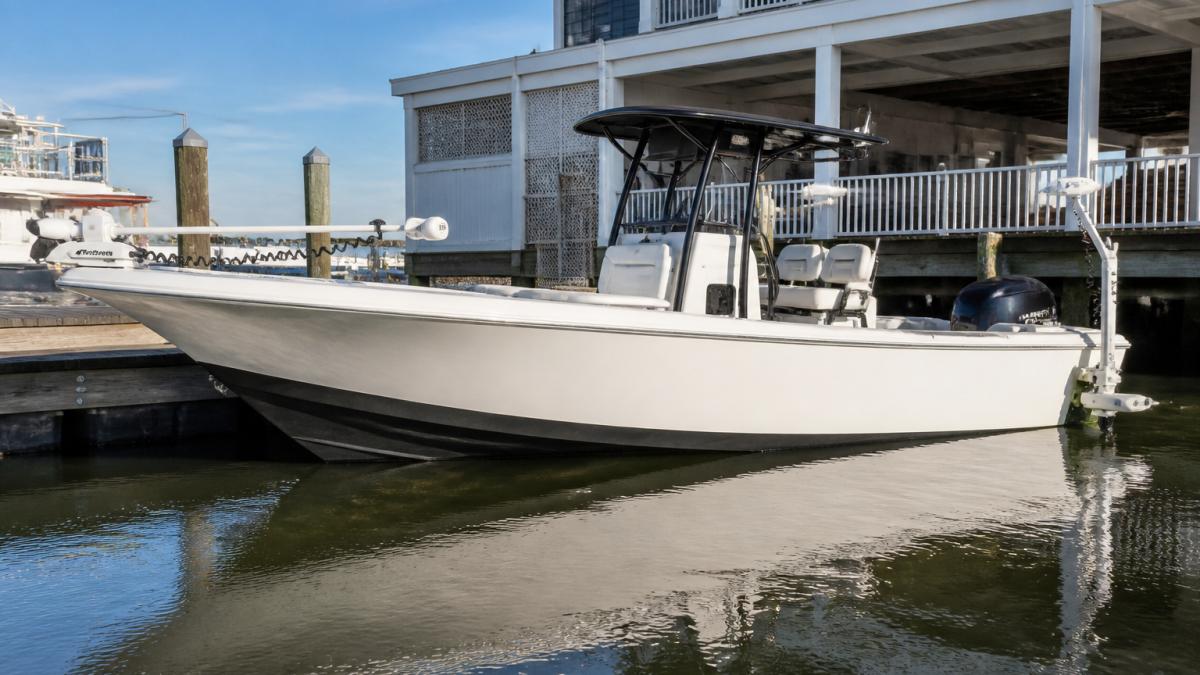
Transom-mount motors attach to the stern. They're easier to install, work well for boats under 25 feet, excel at pushing forward or holding position while drifting, and are simpler to maintain.
Offshore fishing often favors bow-mount motors for precision positioning.
Bow mounts require more installation complexity and a dedicated bow platform.
Dedicated offshore boats usually run bow mounts; smaller or multi-purpose boats often stick with transom mounts.
Motor Size and Hull Compatibility
An undersized motor exhausts batteries quickly and fails to hold position in wind, while an oversized motor wastes power and money.
Motor size is measured in pounds of thrust. Use 5 pounds per 1,000 pounds of boat weight for basic positioning, but offshore conditions demand 7-10 pounds per 1,000 pounds.
Hull design also matters: deep-V hulls handle offshore conditions well but require more thrust than flat-bottom designs, and catamarans distribute weight differently than monohulls.
Offshore Trolling Motor Thrust: Matching Power to Boat Size
The right thrust keeps you positioned over fish; too little leaves you fighting the elements, and too much wastes battery capacity.
Calculating Thrust Requirements for Your Offshore Boat
Start with your boat's total weight, including fuel, gear, and passengers. Multiply by 0.005 for basic freshwater trolling, or 0.007-0.010 for offshore fishing.
Example: An 8,000-pound boat needs 40-80 pounds of thrust offshore. In moderate wind and current, aim for the middle of that range, around 55-60 pounds.
Shallow bays with minimal current need less thrust than open water with constant wind and tidal flow; boats in strong current or windy areas benefit from the higher end of the range.
Thrust Performance in Challenging Conditions
A motor rated at 80 pounds of thrust delivers that force only in ideal conditions.
That's why offshore anglers often choose motors rated higher than basic calculations suggest: a 70-pound motor offshore often performs like a 50-pound motor in calm water.
Newer saltwater-rated motors use improved blade designs and sealed bearings that hold rated thrust after hours of continuous operation, whereas older motors lose efficiency as components wear.
Trolling Motor Battery Runtime: Power and Endurance
Offshore fishing demands extended runtime, so you need batteries that deliver consistent power for 6-8 hours of active fishing.
Voltage Selection and Battery Capacity for Offshore Use
Most trolling motors run on 12-, 24-, or 36-volt systems.
A 12-volt system suits smaller boats and entry-level setups but limits runtime and motor power.
A 24-volt system is the sweet spot for many offshore anglers: substantial power, reasonable runtime, and readily available marine batteries.
A 36-volt system delivers maximum power and runtime but requires three batteries instead of two, taking more space and costing more upfront. Serious offshore anglers running larger boats often choose 36-volt systems for the extra endurance and power reserve.
Battery capacity is measured in amp-hours (Ah). A 100 Ah battery stores twice the energy of a 50 Ah battery.
Runtime Calculations for Extended Fishing Days
Runtime depends on battery capacity (Ah), motor thrust setting, and voltage system.
A typical 24-volt, 100 Ah lithium system running a 70-pound motor at full thrust delivers roughly 4-5 hours of runtime; at 50% throttle, that extends to 8-10 hours. That's why many offshore anglers run partial throttle when holding position, since full thrust isn't needed to maintain location in most conditions.
For 8-hour fishing days, plan for a 150+ Ah battery system (two 75 Ah batteries in a 24-volt setup, or three in a 36-volt system) to get comfortable runtime with reserves for unexpected wind or current changes.
Lithium batteries charge faster than lead-acid and maintain voltage longer throughout the discharge cycle, costing more upfront but delivering better value over time through improved performance and lifespan.
Offshore Trolling Motor GPS Anchoring and Positioning
Modern trolling motors integrate GPS and sonar, transforming offshore fishing. Position-holding features keep you over structure without constant manual adjustment, freeing you to focus on fishing.
Spot Lock and Anchor Mode Features
Spot Lock (or similar anchor-mode features on competing brands) uses GPS to hold your boat's position within a few feet.
Anchor mode works best in moderate wind and current; in extreme conditions the motor may struggle to maintain position but will keep you close to your target.
GPS integration also enables waypoint navigation: mark productive spots, save them to memory, and return to exact locations on future trips, building a personal database of your best fishing areas.
Sonar Integration and Fish Finder Compatibility
Quality offshore trolling motors connect directly to your fish finder, displaying motor position on your sonar screen and showing your boat's exact location relative to structure, which is critical for precision fishing.
Some motors display sonar directly on the control head, eliminating the need to look away from your primary screen and letting you make faster positioning adjustments based on what the sonar shows.
Compatibility matters: ensure your trolling motor, fish finder, and GPS communicate properly.
Steering Options and Remote Control for Offshore Conditions
How you control your trolling motor affects fishing efficiency and safety, and offshore conditions demand responsive, reliable steering.
Foot Pedal, Cable, and Wireless Control Systems
Foot-pedal steering is traditional: your feet control direction while your hands stay free for fishing.
Cable-steer systems connect the motor to a helm-mounted wheel or joystick, keeping controls centralized with precise directional feedback.
The best offshore setup often combines methods. A primary wireless remote for active fishing, with foot-pedal backup if the wireless system fails. Redundancy matters offshore.
Reliability and Response in Rough Water
Steering response time matters when waves move your boat: a sluggish system means delayed corrections and drift off target. Quality offshore motors adjust quickly to wind and wave-induced movement.
Test steering response before committing: ask about lag time and rough-water performance. Sealed connectors and waterproof wiring ensure reliability even when spray and wave wash hit the steering controls.
Saltwater Durability and Long-Term Maintenance
Buying an offshore trolling motor is a significant investment. Proper maintenance extends lifespan and keeps the motor performing reliably for years.
Stainless Steel and Corrosion-Resistant Coatings
The best saltwater trolling motors use stainless steel for propellers, shafts, and fasteners. Stainless steel resists corrosion far better than standard steel or aluminum. Check component materials before purchasing, stainless steel construction is a sign of quality.
Anodized aluminum housings and marine-grade protective coatings add another layer of corrosion protection, creating a barrier between metal and saltwater.
Maintenance Intervals and Lifespan Expectations
Rinse your motor with fresh water after every saltwater outing to remove salt residue that accelerates corrosion.
Inspect propellers and shafts monthly during the season for corrosion spotting or damage, addressing issues early before they spread, and replace propellers that show significant corrosion or damage.
Annual professional servicing is recommended for motors used regularly in saltwater. A qualified technician flushes internal passages, inspects bearings, checks seals, and replaces worn components, extending lifespan significantly.
A well-maintained saltwater trolling motor lasts 8-12 years with regular use, while motors with minimal maintenance may fail within 3-5 years. The difference is corrosion prevention and addressing wear before it becomes catastrophic.
| Maintenance Task | Frequency | Impact |
|---|---|---|
| Fresh water rinse | After each saltwater use | Removes salt residue, prevents corrosion |
| Visual inspection | Monthly during season | Catches corrosion and damage early |
| Propeller cleaning | Monthly | Maintains thrust efficiency |
| Professional service | Annually | Extends motor lifespan 2-3 years |
| Protective coating reapplication | Every 2-3 years | Restores corrosion barrier |
Selecting and Installing Your Offshore Trolling Motor
Choosing the right motor requires matching specifications to your boat, fishing style, and budget.
Start with your boat's weight, typical fishing environment, and preferred mounting location.
At Marine Electronics Depot, we stock a comprehensive selection of saltwater trolling motors from leading brands.
Installation should follow the manufacturer's specifications exactly. Improper mounting can damage your boat or create safety hazards.
Frequently Asked Questions
What thrust do I need for an offshore trolling motor?
Thrust requirements depend on boat weight, wind conditions, and current strength. A general rule is 5 pounds of thrust per 200 pounds of boat weight for freshwater; offshore vessels in wind and current typically need 1.5 to 2 times that amount. A 25-foot offshore fishing boat (8,000-10,000 pounds) usually requires 55-80 pounds of thrust for reliable position holding in moderate conditions. Check your boat's specifications and local water conditions to calculate the right offshore trolling motor thrust for your setup.
How long will a battery run a saltwater trolling motor?
Trolling motor battery runtime depends on voltage, capacity, and thrust level. A 36-volt, 100Ah lithium battery may run a 55-pound motor for 8-12 hours at half speed in calm conditions; offshore use with higher thrust and rougher water reduces that to 4-6 hours. Runtime also decreases in cold water and when fighting wind or current. Calculate your expected fishing day length and choose battery capacity accordingly; many offshore anglers carry dual battery banks or a secondary power source for redundancy.
Can a trolling motor hold a boat in place offshore?
Yes, trolling motors with GPS anchoring and spot lock features can hold position offshore, but only in moderate conditions. Wind, current, and waves will eventually overcome the motor's holding power if they exceed the thrust rating. A properly sized offshore trolling motor with GPS anchoring works well for precise positioning over a fishing spot, but for extended offshore anchoring in rough conditions, a dedicated anchor system is more reliable and fuel-efficient than relying solely on the trolling motor.
Are saltwater trolling motors different from freshwater models?
Yes, saltwater trolling motors differ significantly in construction and materials. Saltwater models use stainless steel, corrosion-resistant coatings, and sealed electronics to withstand salt exposure and spray. Freshwater motors lack these protections and will corrode rapidly in saltwater environments. If you fish offshore, choose a motor specifically rated for saltwater use; using a freshwater-only model in salt will void the warranty and result in premature failure within months.

